
Tinnitus UK improves treatment information sheets
We're changing our treatment information sheets to better reflect the latest research evidence
Providing you with independent, trustworthy information on tinnitus is one of the most important parts of our role as your national charity.
To better reflect the latest research that is out there, we are restructuring our treatment information sheets, helping you and your care providers make better decisions.
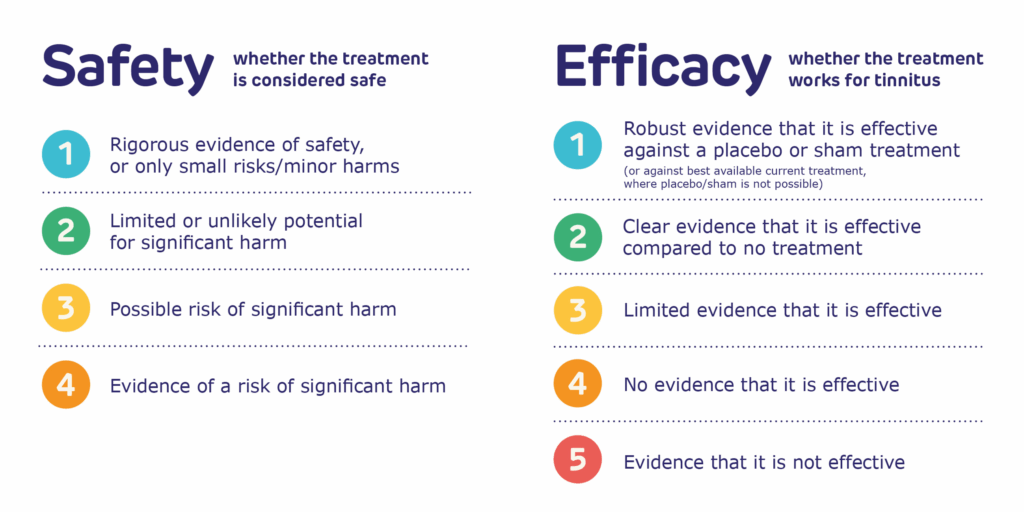
Instead of the previous “recommendation” system, treatments are now rated in two key areas:
Safety: whether the treatment is safe, ranging from rigorous evidence of safety to evidence of significant harm.
Efficacy: whether there is evidence that the treatment works for tinnitus, ranging from robust evidence of effectiveness to evidence that it is not effective.
We hope this will give you more control over your own care, while also helping you can make the best decision possible.
How do treatment sheets work?
The most powerful way to tackle tinnitus is by learning about it. As we learn, we help retrain our brains out of the “fight or flight” response that can make tinnitus so intrusive. The more we know, the more control we have, and the less challenging our tinnitus becomes.
Misinformation and confusion, therefore, are among the greatest challenges facing people living with tinnitus.
Tinnitus UK has a group of expert volunteers who form the Professional Advisory Committee (PAC). They work closely with the Tinnitus UK team, routinely reviewing new research on different aspects of tinnitus, including treatments. Their assessment informs our guidance, including our treatment information sheets.
Ok, but why now?
This new framework is needed because of the increasing quantity of tinnitus research happening around the world, and the wide range of approaches being covered. It means you can differentiate the good from the bad more easily, and we can clearly show when the quantity of good research tips the balance.
The new levels also hold researchers and institutions to higher standards, making it clear that the tinnitus community deserves high quality studies and investment in treatments and cures.
Importantly, we want you to be as informed as possible and make treatment decisions that are right for you. We strongly recommend speaking to your hearing health professional to find the most suitable options for you.
Recognising new evidence
For example, in recent months, evidence has grown for the effectiveness of the bimodal neuromodulation device Lenire®.
In line with this new framework, following advice of PAC, Lenire will be upgraded to a rating of 1 for safety and 2 for efficacy.
This means it is considered very safe, with clear evidence of effectiveness compared to no treatment – a level of efficacy currently matched only by professional cognitive behavioural therapy (CBT) and hearing aids. This reflects the growing body of evidence being published that shows the efficacy not just of bimodal neuromodulation, but the Lenire® device specifically.
For transparency, a full list of research papers reviewed by PAC can be found on all treatment sheets when they are published.
Ongoing changes
Over the coming weeks, we will continue to update all our treatment sheets and make our information pages easier to navigate. We appreciate your patience while we make this change.
As ever, if you come across any new treatments you think we should be aware of, please email [email protected].
For the latest updates and to explore our treatment information sheets, please visit the Treatment Sheet page below.