
What does a safe listening festival sound like? Tinnitus UK at ArcTanGent Festival
This year, we have been actively working in the music industry, asking a simple question: how can we make live music safer without taking away what makes it so brilliant?
Following our work during Tinnitus Week 2026 and Download Festival, we took our safe listening conversation a step further at ArcTanGent, a four-day, four-stage exploration of the experimental, the progressive and generally quirky corners of the musical spectrum.
This year, ArcTanGent became the UK’s first Safe Listening Festival, with researchers from the Manchester Centre for Audiology and Deafness (ManCAD) on site to put the World Health Organization’s Global Standard for Safe Listening at Venues and Events into practice. The WHO standard is designed to help people enjoy amplified music while reducing the risk to their hearing.
As anyone who has spent a weekend at ArcTanGent will know, loud music is very much part of the experience. The festival brings together thousands of passionate music fans and some wonderfully uncompromising bands; from extreme metal and post-rock to electronic music, experimental sounds and everything in between.
The challenge was to see whether hearing health could become part of that experience without getting in the way of it.
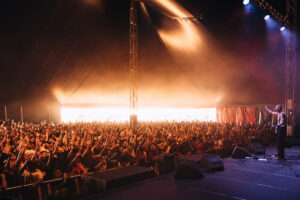
Putting safe listening into practice
ManCAD’s team had two jobs at the festival: help implement the WHO standard and research how it worked in the real world.
That meant working with the festival on measures including sound level monitoring, recommended sound level limits and sound system design, alongside making hearing protection more accessible and providing training for festival staff through the HELA initiative.
Earplugs were available throughout the site, with free foam earplugs at the stage barriers and high-fidelity earplugs available to buy at the merch stand and Metal For Good tent.
For regular festivalgoers, that might sound like a small change. But making hearing protection easy to find and easy to use is an important part of creating a safer listening environment. The WHO standard specifically recommends making personal hearing protection available to audiences, alongside sound monitoring, quiet areas and staff training.
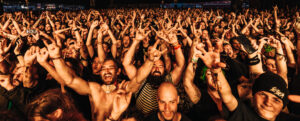
There was already a strong culture of hearing protection among the ArcTanGent crowd. Our volunteer on site noticed that more than half of the audience appeared to be wearing earplugs, with the proportion increasing closer to the stages.
As a long-time festivalgoer, they described this as particularly encouraging, especially at a festival where the line-up includes some seriously loud music.
“I can’t pretend that ArcTanGent is anything other than a loud weekend, but an audience as passionate about their music as this one, means they are by far the most aware of the importance of hearing protection.”
That doesn’t mean the music experience was diminished.
In fact, our volunteer was struck by the clarity of the sound across the larger stages, even during some of the weekend’s most intense performances. At no point did they experience the uncomfortable feeling of sound being simply too loud behind their earplugs.
And that’s an important part of what safe listening is about.
It isn’t about making live music quiet. It’s about making it safer to enjoy.
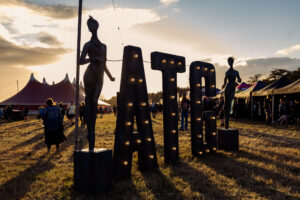
Researching what works
Alongside helping implement the safe listening measures, ManCAD researchers were conducting research throughout the festival.
They spoke with sound technicians, artists, festival staff and festivalgoers, gathering feedback on listening behaviours, awareness of hearing health and how people experienced the changes.
The aim was to understand not just whether the WHO standard can be implemented at a festival, but whether the measures are practical and acceptable to the people who actually make and experience live music.
The conversations were encouraging, with people generally responding positively to the approach.
Dr Samuel Couth, Lecturer at the Manchester Centre for Audiology and Deafness, said:
“Live music is such an important part of our culture and everyday lives, but it’s equally important that we think about how we can make these environments safer for the people in them. We want to put hearing health into practice, while recognising that enjoying loud music and protecting your hearing don’t have to be mutually exclusive. We are looking forward to working with Tinnitus UK, and continuing to explore how we can support safer listening across the live music industry.”
Loud music, smarter listening
ArcTanGent was a particularly fitting place to test this approach.
There’s no need to convince this crowd that music matters, this is a festival built around people who travel to a farm in the Mendips to spend four days listening to the furthest things away from mainstream music.
And that passion is exactly why conversations about hearing health matter.
People aren’t going to stop going to gigs because they are told loud music carries risks. Nor should they have to.
Instead, hearing protection, sound monitoring, breaks from loud sound and better information should become a normal part of the live music experience.
If you’ve ever stood at the front of a stage with your favourite band playing, you’ll know there’s something pretty special about being surrounded by thousands of people who are completely absorbed in the same music.
We want people to be able to keep doing that for years to come.
From Tinnitus Week 2026, to our work across festivals this summer, we’re continuing to build relationships across the music industry and explore what safer listening can look like in practice.
There’s more work to do, and more research to come, but ArcTanGent has shown that protecting hearing and loving loud music really don’t have to be mutually exclusive.
So, wherever you’re heading for your next gig or festival: enjoy the music; and pack your earplugs.
Images via: arctangent.co.uk